The difference between training and practice
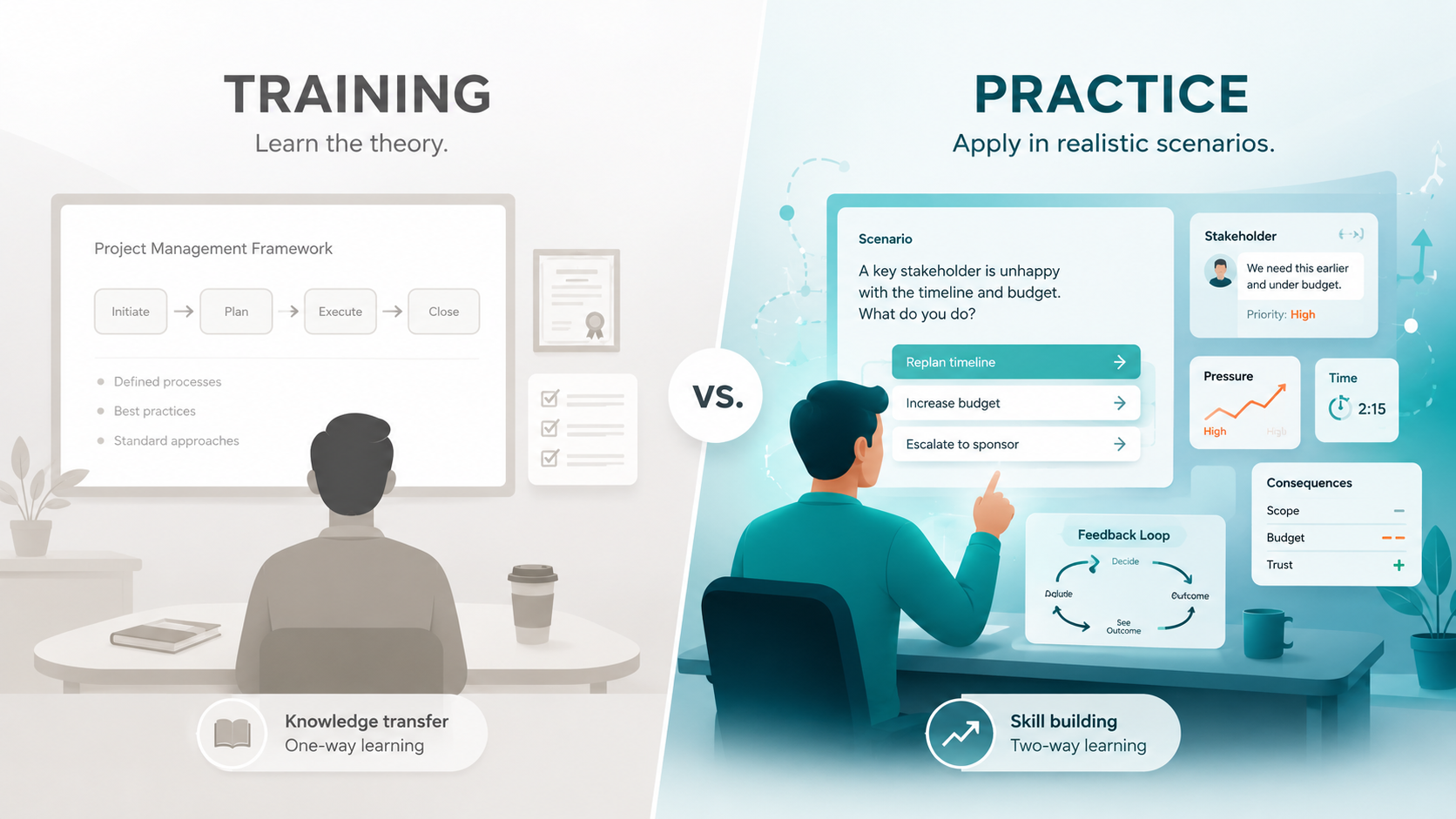
Organisations spend significant money every year developing their people. Workshops, e-learning modules, leadership programmes, competency frameworks — the investment is real, and the intention behind it is genuine. So why does so much of it fail to produce a visible change in how people actually perform under pressure?
The answer lies in a distinction that the learning and development industry has struggled to make clearly: the difference between training and practice.
They are not the same thing. And confusing them is expensive.
What training actually is
Training is the transfer of knowledge or information. It tells people what to do. It explains frameworks, introduces concepts, demonstrates techniques. At its best, training is efficient, well-structured, and clearly communicated. A person leaves knowing something they did not know before.
That is genuinely useful. But it is also the easy part.
The problem is that most L&D programmes stop there. They measure success by completion, did the person attend, did they pass the assessment, did they receive the certificate. The question of whether they can actually apply what they learned in a real situation, under real pressure, with real consequences, rarely gets asked. And when it does, the answer is often uncomfortable.
Knowledge acquired in a calm, structured environment does not automatically transfer to a chaotic one. A person can know exactly what good prioritisation looks like and still freeze when three urgent requests arrive simultaneously. They can articulate the principles of effective escalation and still hold on to problems too long when the moment comes. Knowing and doing are not the same skill.
What practice actually is
Practice is different in a fundamental way. It is not about receiving information. It is about building capacity through repeated exposure to the kinds of situations where that capacity is needed.
A musician does not become better by reading about technique. They become better by playing; making mistakes, adjusting, playing again. A footballer does not develop match awareness through lectures on positioning. They develop it through repetition on the training pitch, under conditions that simulate the pressure and unpredictability of a real game.
In professional settings, we accept this logic for some skills like public speaking, for example, or sales. We know that people get better at those things by doing them, not by reading about them. But for the broader set of everyday professional decisions such as how to prioritise, when to escalate, what to protect, and how to manage competing demands, we still default to training as if knowledge transfer is sufficient.
It is not. And the gap shows up clearly when pressure increases.
What deliberate practice looks like for decision-making
The challenge with decision-making as a practice discipline is that real decisions carry real consequences. You cannot ask someone to make a series of high-stakes calls just to see what they learn from the experience. The cost of getting it wrong in the real world is too high, and the feedback loop is often too slow.
This is exactly where simulation becomes valuable. Not as a replacement for experience, but as a way of accelerating it.
Effective decision practice puts people inside realistic situations, scenarios with the same time pressure, competing demands, and imperfect information that characterise actual work. It requires them to make real choices, not theoretical ones. And it makes the consequences of those choices visible immediately, so the feedback loop that real experience provides over months can be compressed into minutes.
Over repeated runs, patterns emerge. A person starts to see how they tend to decide under pressure — what they protect, what they delay, what they avoid. That visibility is what makes change possible. You cannot adjust a habit you cannot see.
The organisational case
For organisations, the distinction between training and practice has a direct line to performance. A team that has been trained knows what good decisions look like. A team that has practised is more likely to make them, especially when it matters most.
The question worth asking of any L&D investment is not just what people will know after it. It is what they will be able to do differently when the situation is messy, the time is short, and the options are all imperfect.
Training answers the first question reasonably well. Practice is what answers the second.